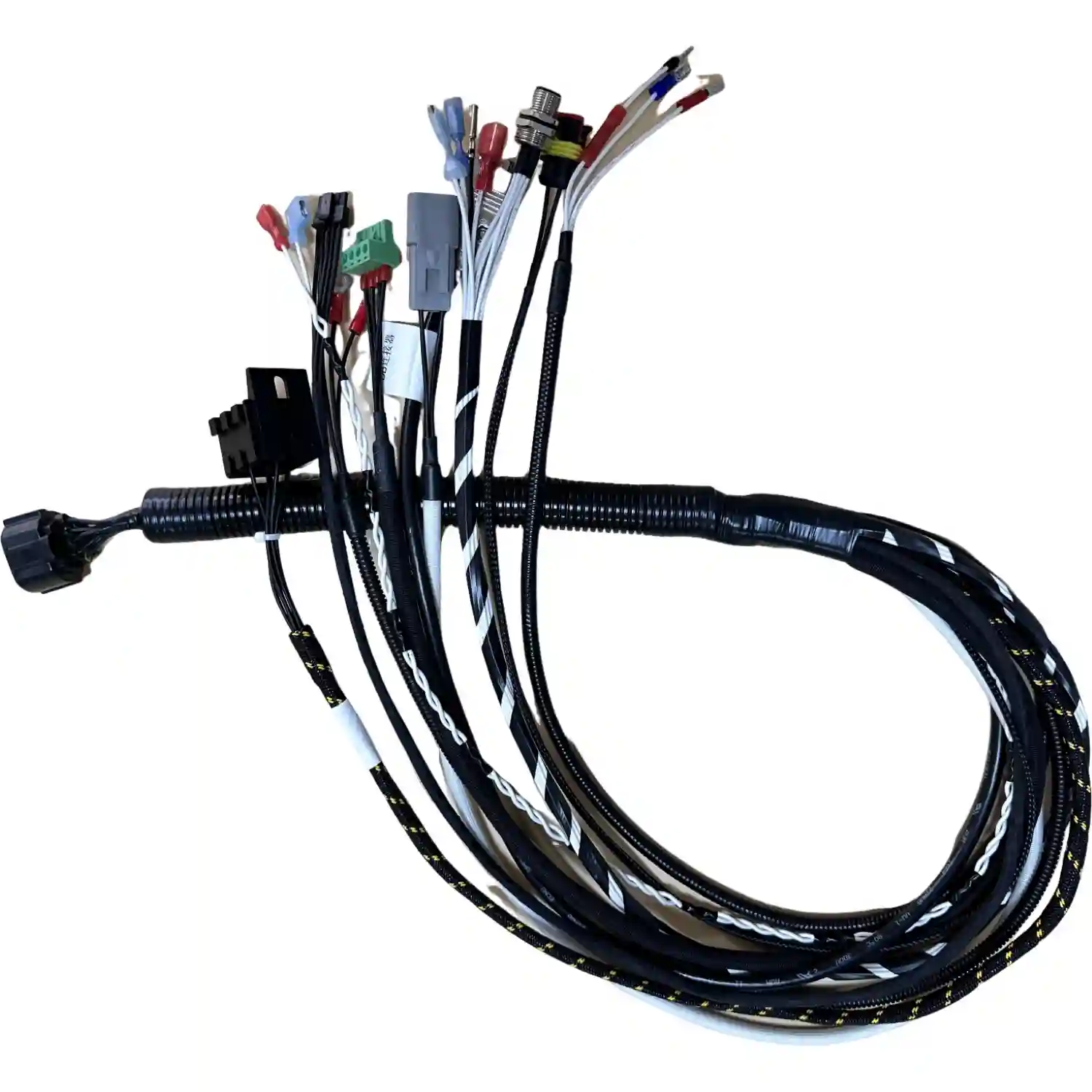

"What gauge should I use for 20 amps?" — there are five different correct answers depending on which standard you read, how many other wires are bundled with yours, what insulation you specified, and whether your customer's compliance team works to NEC or UL. The internet's first-page wire-gauge tables ignore most of these variables. This is the field guide we use during DFM review when an engineer sends a drawing without a wire spec.
What AWG actually is
Wire Gauge (AWG) is a geometric series for solid copper wire diameters. Each step down in AWG number is roughly a 26% increase in cross-sectional area. AWG 0 (zero gauge) is roughly 8.25 mm diameter; AWG 40 is 0.08 mm. The standard is over 150 years old and now coexists awkwardly with metric cross-section ratings (mm²) used by IEC and most non-US OEMs. The Wikipedia AWG entry has the authoritative diameter-to-area conversion table.
AWG alone tells you nothing about current rating. That depends on insulation temperature rating, ambient temperature, bundle configuration, and the standard your installation is governed by.
NEC vs UL ampacity — the gap that surprises buyers
Two ampacity tables dominate cable assembly work in North America:
- NEC (National Electrical Code) Table 310.16 — governs building wiring in walls and conduit. Used by US electrical inspectors. Conservative.
- UL 758 chassis-wiring ampacity tables — govern internal wiring of equipment (panels, machines, devices). Used by UL listing engineers. Less conservative because chassis wiring sees better airflow than walled-in conductors.
The two tables can differ by 50% on the same gauge wire. AWG 18 stranded copper carries about 7 amps under NEC Table 310.16 (60°C insulation) but is rated 16 amps under UL 758 free-air chassis ampacity. Quote the wrong table and your harness either looks dangerously undersized or absurdly overspecified.
For B2B cable assemblies built into equipment, UL 758 is almost always the right reference. NEC applies to your customer's facility wiring, not to the wires inside the box you ship them. The NEC scope on Wikipedia clarifies this distinction.
Single conductor in free air — the baseline table
For 80°C-rated PVC insulation (the workhorse of industrial wiring, UL 1015), in free air at 25°C ambient, single conductor, no bundle derating:
| AWG | Diameter (mm) | Resistance (Ω/km) | UL 758 free-air ampacity (A) | Typical use |
|---|---|---|---|---|
| 26 | 0.40 | 133.9 | 3 | Signal, low-current sensors |
| 24 | 0.51 | 84.2 | 3.5 | USB, ribbon cable |
| 22 | 0.64 | 52.9 | 5 | Signal-level harness, JST GH/SH |
| 20 | 0.81 | 33.3 | 11 | General-purpose control |
| 18 | 1.02 | 20.9 | 16 | Molex Mini-Fit Jr applications |
| 16 | 1.29 | 13.2 | 22 | Power feed, medium current |
| 14 | 1.63 | 8.3 | 32 | AC mains, contactors |
| 12 | 2.05 | 5.2 | 41 | Motor feed, heavy contactor |
| 10 | 2.59 | 3.3 | 55 | Battery feed, high-current bus |
| 8 | 3.26 | 2.1 | 73 | EV traction, large motor feed |
| 6 | 4.11 | 1.3 | 101 | EV main pack-to-inverter |
| 4 | 5.19 | 0.82 | 135 | Heavy traction, battery bus |
These numbers are conservative free-air ratings. The instant you bundle wires together, they drop.
Bundle derating — the number nobody publishes
Inside a harness, wires share thermal mass. Each conductor heats its neighbors, and the bundle as a whole loses thermal conductivity to ambient. Bundle derating factors used in industry practice (NEC Table 310.15(B)(3)(a) and UL guidance):
| Number of current-carrying conductors | Ampacity derating factor |
|---|---|
| 1-3 | 1.00 |
| 4-6 | 0.80 |
| 7-9 | 0.70 |
| 10-20 | 0.50 |
| 21-30 | 0.45 |
| 31-40 | 0.40 |
| 41+ | 0.35 |
So your AWG 18 wire rated 16 amps in free air drops to 8 amps in a 20-wire harness. This is why a thumb-rule "AWG 18 = 16 amps" gets installations into trouble.
Signal wires (carrying less than 10% of their ampacity rating) do not count toward the derating tally. Only current-carrying conductors. A 30-wire harness where 20 are signal lines counts as a 10-conductor bundle for derating purposes.
Insulation temperature rating and ambient
Higher temperature-rated insulation extends ampacity. UL 758 ampacity scales with insulation rating in this rough proportion:
- 60°C insulation (PVC, basic UL 1007): baseline ampacity from tables above.
- 80°C insulation (UL 1015 PVC): +15% over baseline.
- 105°C insulation (UL 1061, FEP): +30%.
- 200°C insulation (silicone, PTFE, MIL-W-22759): +50% to +80% depending on construction.
If your operating ambient is hot — say a motor bay or an enclosure with no airflow — you need to derate further. Roughly subtract the headroom between rated insulation and actual ambient, and reduce ampacity by 5% per 10°C reduction in headroom.
The voltage-drop check that catches everyone
Ampacity tables tell you when the wire will overheat. They do not tell you when the voltage drop along the wire makes your load misbehave. For a long harness run, voltage drop is the real constraint.
The formula: V_drop = 2 × I × L × R / 1000, where I is current in amps, L is one-way length in meters, R is resistance in ohms per kilometer (from the table above), and the factor of 2 is round-trip.
For 24VDC industrial control, a 5% drop is the practical limit. For 12V automotive accessory loads, 3% is the design target. For 48V or 800V EV systems, voltage drop is mostly a power-loss / efficiency calculation rather than a misbehavior one — but at 100A on a 6-meter cable, even tenths of a milliohm matter. For high-voltage programs we model the resistance budget at the harness-design stage, not the wire-pick stage.
How we pick gauge during DFM review
For a typical RFQ where the drawing does not specify gauge, our DFM engineer walks this decision tree:
- Look up steady-state current per circuit.
- Count current-carrying conductors in the bundle. Apply derating factor.
- Pick the smallest AWG that exceeds the derated requirement with 20% headroom.
- Compute voltage drop. If it exceeds budget, go up one or two AWG.
- Check the connector pin rating. Connector pin limits sometimes cap you before the wire does.
- Check the customer's spec for minimum gauge floor (some MIL specs disallow anything finer than AWG 22).
The drawing review takes about 4 hours for a typical 50-circuit harness. We do this on every custom wire harness intake.
Case in production
For machinery OEM harnesses, wire gauge is reviewed during sample quoting so the proposed construction reflects the actual electrical and mechanical load.
Selection criteria: Current, bundle size, ambient temperature, voltage-drop budget, and connector-pin ratings are considered together rather than treated as separate checks.
What we do: Apply bundle and temperature derating, select a conductor with 20% current headroom, calculate round-trip voltage drop, and verify the result against the connector rating and drawing requirements.
Result: Sample builds and production releases use the same documented gauge-selection basis and acceptance limits.
Concrete numbers: 20% current headroom; round-trip voltage-drop calculation; connector-pin rating verified