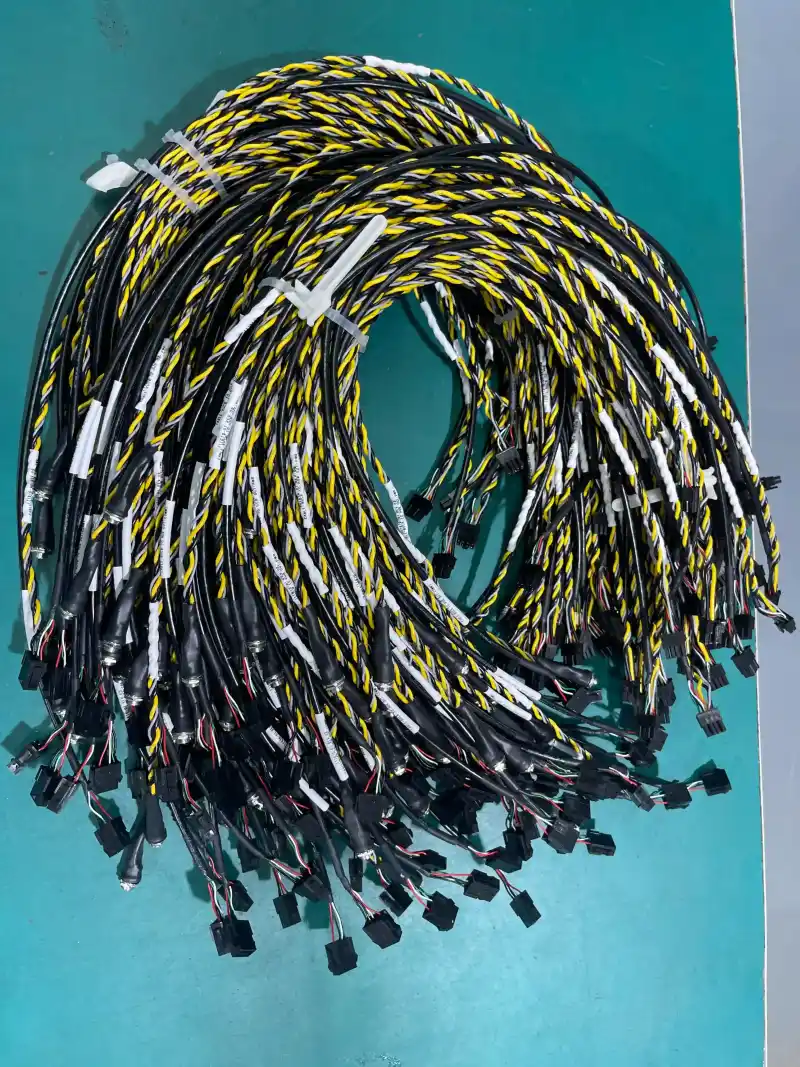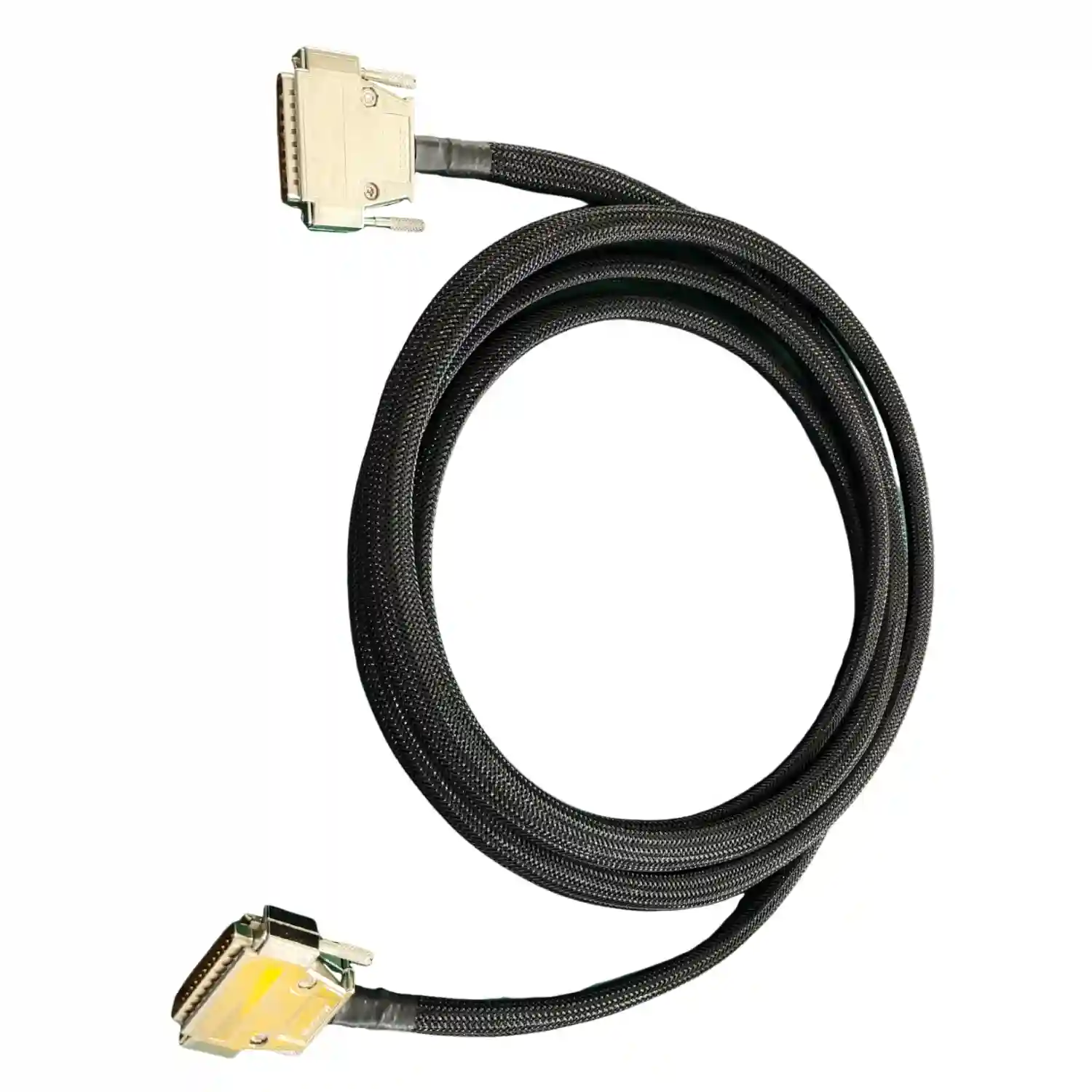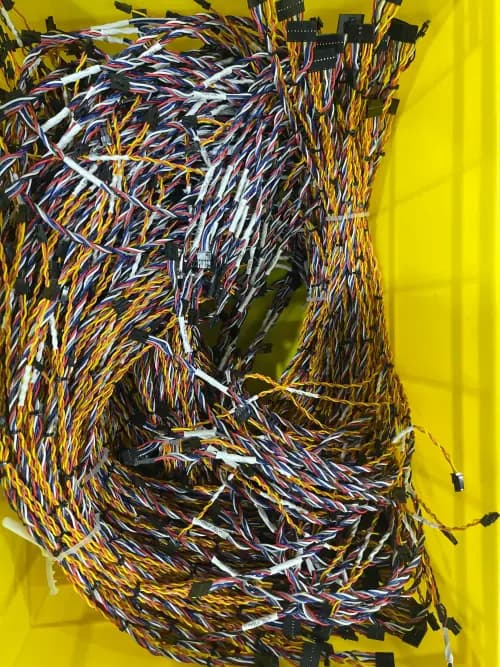

A 300 mm BNC jumper can pass continuity and still fail the product if the RFQ says "RG58 or RG59 equivalent." RG58 is a 50 ohm coax family. RG59 is a 75 ohm coax family. That mismatch changes connector geometry, loss budget, strip program, and test acceptance before production cuts the first lot.
This is the decision path we use when quoting Cable Assembly (hub) work that carries antenna, radio, camera, video, GPS, or sensor signals. The jacket looks similar enough to confuse purchasing. The electrical path is not similar enough to substitute without engineering approval.
The short answer: choose by impedance first
RG58 belongs in 50 ohm RF paths. RG59 belongs in 75 ohm video, CCTV, SDI-adjacent, and some instrumentation paths. Diameter, jacket color, and connector shell size are secondary checks after the impedance is locked. A 50 ohm BNC and a 75 ohm BNC may both twist onto a panel, but the center-pin and dielectric geometry are different enough that a purchasing substitution can become a return-loss problem or a damaged female contact.
The safest RFQ language is not "RG58/RG59 acceptable." It is "50 ohm RG58, Belden 8240 or approved equivalent" or "75 ohm RG59, Belden 8241 or approved equivalent," followed by connector series, cable length, tolerance, and test requirement. If the assembly routes into a radio, antenna, GNSS receiver, spectrum analyzer, or embedded wireless module, start with RF Cable Assemblies selection logic. If it routes into video capture, inspection camera, CCTV, or legacy analog instrumentation, start with the 75 ohm requirement.
| Decision point | RG58 reference | RG59 reference |
|---|---|---|
| Nominal impedance | 50 ohm family; Belden 8240 actual impedance spec is 51.5 +/- 1.5 ohm | 75 ohm family; Belden 8241 lists 75 ohm characteristic impedance |
| Common use | Low-power RF, two-way radio, GPS, RFID, wireless antenna leads | Analog video, CCTV, SDI-adjacent patching, 75 ohm instrumentation |
| Example center conductor | 20 AWG solid bare copper on Belden 8240 | 23 AWG solid bare copper covered steel on Belden 8241 |
| Example outside diameter | 0.193 in (4.90 mm) on Belden 8240 | 0.240 in (6.10 mm) on Belden 8241 |
| Example shield | 95% tinned copper braid | 95% bare copper braid |
| Example electrical data | 28.5 pF/ft capacitance; 66% velocity of propagation; 14.5 dB/100 ft at 1000 MHz | 20.4 pF/ft capacitance; 66% velocity of propagation; 1700 V voltage rating |
Those are reference-stock examples, not universal values for every cable carrying the RG name. The point is the sourcing discipline: compare manufacturer part numbers and datasheets, not only the RG family marking on the jacket.
Where RG58 is the correct choice
Choose RG58 when the connected system is designed around a 50 ohm port. That covers most low-power RF and antenna work: VHF/UHF radios, GPS/GNSS antenna feeds, RFID readers, wireless telemetry, and some bench-instrument jumpers. The assembly may terminate to BNC, TNC, N-Type, SMA, or another 50 ohm interface, but the connector must be specified as the 50 ohm version. A BNC callout without impedance is an incomplete BOM line.
RG58 is not a cure for high-frequency loss. Belden 8240 lists 3.8 dB/100 ft at 100 MHz and 14.5 dB/100 ft at 1000 MHz. On a 150 mm internal jumper, that loss may be irrelevant. On a 10 m antenna lead, it may break the link budget. If the RF path is above 1 GHz, has tight insertion-loss limits, or carries calibrated measurement data, RG316, RG142, LMR-200, or semi-rigid coax may be a better starting point than either RG58 or RG59.
Mechanically, RG58 is smaller than RG59 in the common references above: 0.193 in versus 0.240 in outside diameter. That helps in tight enclosures, but it also means the ferrule, die cavity, boot, and strain relief have to match the cable exactly. Using an RG59 ferrule on RG58 can leave braid compression low enough to pass a pull check once and then drift after vibration.
Where RG59 is the correct choice
Choose RG59 when the port is 75 ohm. That usually means video, CCTV, inspection-camera signal, broadcast-adjacent patching, and some older instrumentation paths. For Coaxial Cable Assemblies, we treat 75 ohm as a design requirement, not a purchasing preference. If the camera output, receiver input, or test fixture is 75 ohm, swapping to RG58 creates a mismatch even when the assembly lights up during a bench check.
RG59 is often physically larger and less flexible than the RG58 stock many buyers have on hand. Belden 8241 lists a 0.240 in (6.10 mm) nominal diameter, a 2.4 in (61 mm) minimum installation bend radius, and 63 lb (29 kg) maximum pull tension. Those numbers matter when the cable leaves a rotating camera head, routes through a tray, or exits a small enclosure without enough clearance for the boot.
The center conductor construction also changes the assembly risk. A copper-covered steel conductor is common in RG59 video cable because it supports the electrical and mechanical needs of that cable type. It is not handled the same way as a stranded RF jumper during stripping, soldering, or center-pin insertion. The operator needs the correct strip length and blade program for the cable stock that is actually loaded, not for the cable family named in an old drawing note.
Connector and test requirements change with the cable
The connector is where many RG58/RG59 substitutions become visible. BNC is the common trap because both 50 ohm and 75 ohm versions are common, serviceable, and visually close. TNC, N-Type, and F-type choices also follow the signal path. The RFQ should name connector gender, impedance, body style, orientation, plating if required, and the manufacturer's approved cable group. "BNC male to BNC male, 500 mm" is not enough information for a controlled production build.
Tooling has to follow that cable-and-connector combination. On RF crimps, the manufacturing partner uses matched hex-crimp tooling such as Daniels DMC AFM8 or M22520/5-01 style frames where the connector OEM calls for that system. The partner sets the die cavity, ferrule OD, braid foldback, center-contact position, and jacket support from the connector datasheet. The same operator cannot safely run RG58 and RG59 from one generic die and expect repeatable RF performance.
Continuity is necessary but not sufficient. A short/open test on a Cirris 1000H catches gross wiring faults. It does not prove that a 75 ohm camera feed stayed 75 ohm after braid trim, dielectric compression, and connector seating. For RF-sensitive builds, the drawing should state the required check: insertion loss, return loss, VSWR, TDR impedance, or a swept test on a Keysight FieldFox N9952A or equivalent instrument. If the customer only requires continuity, we still lock the cable and connector part numbers so a later RF failure cannot be traced to an undocumented substitution.
How VeinWire handles this on customer programs
Our first gate is DFM. Before quote release, engineering checks impedance, cable manufacturer part number, connector family, finished length, length tolerance, bend radius, strip dimensions, packaging, and the test record required by the buyer. For workmanship, VeinWire requires the manufacturing partner's build traveler to cite IPC/WHMA-A-620 where harness operations apply. For cable compliance, the BOM calls out the actual material standard or cable construction requirement, such as UL 758 or MIL-DTL-17 when the program requires military-grade coax control.
After requirements are released, VeinWire coordinates the control plan and places the order with the manufacturing partner. At the partner's kitting station, RG58 and RG59 stock is separated by part number and pulled against the traveler, not by visual jacket comparison. The partner verifies the strip setup on the first article and checks center conductor exposure, dielectric face, braid foldback, ferrule placement, and jacket support before the lot moves. For crimp-style connectors, the partner performs crimp-height or die-closure verification where the tooling supports it, plus a pull check per connector OEM requirement when the contact design allows it.
The manufacturing partner ties testing to the failure mode. Prototype and first-article lots get 100% visual inspection and 100% continuity. If the assembly carries an RF or video signal where impedance matters, VeinWire requires the customer-defined RF test and retains the partner's trace or reading with the lot record. The evidence has to prove the condition that can fail, not just print a pass label.
Case in production: An energy management company needed initial physical samples to validate a complex custom overmolded power cable design before committing to production tooling.
Challenge: Standard production molds for overmolded cable assemblies are costly and time-consuming, creating a barrier for early-stage NPI validation requiring only a handful of units.
What we did: Proposed a rapid prototyping approach using silicone molds instead of hard tooling and coordinated the manufacturing partner's allocation of 50 pieces of raw material for an initial batch of 5 sample units.
Result: Delivered functional samples within a 3-4 week turnaround (including 2 weeks for silicone mold creation), enabling the customer to proceed with physical testing and design iteration without upfront hard tooling investment.
Concrete numbers: 5 sample units produced, 50 pieces raw material allocated, 2 weeks silicone mold creation, 3-4 weeks total sample turnaround
When to contact us
Bring VeinWire in before release if your drawing says "RG58/RG59 equivalent," uses BNC without impedance, mixes 50 ohm RF and 75 ohm video in one harness, or needs a pilot lot of 20-50 assemblies before scale-up. We are also a fit when the assembly will be audited against a drawing package and the buyer expects the cable part number, connector part number, tooling setup, and test record to match across each shipment.
If the RFQ is still being written, use the same level of detail shown in our RFQ Checklist for Cable Assembly orders: cable manufacturer part number, approved alternates, connector impedance, finished length tolerance, bend radius limit, test method, labeling, and packaging. Without those fields, suppliers will make assumptions. With coax, assumptions become measurable electrical defects.
Have a drawing or BOM? Submit it at /contact — engineering walks every drawing within 4 business hours.