
A coax jumper can pass continuity and still fail the link. The open-short test says the center conductor is connected; it does not prove the assembly can carry a 6 GHz antenna path, a 75 ohm camera feed, or a 100 mm AWG#40 micro-coax signal without impedance drift. Transmission speed is a design and test question, not a catalog adjective.
For Cable Assembly (hub) work, we separate three numbers before quote release: propagation delay, usable bandwidth, and the acceptance test. Confusing those three is how a drawing that says "fast coax" becomes a production hold.
Transmission speed is delay before it is data rate
Coaxial cable transmission speed is the velocity of the electrical wave through the dielectric between the center conductor and shield. In vacuum, an electromagnetic wave travels about 300 mm per nanosecond. In a real coax dielectric, the wave is slower. A solid polyethylene coax with a velocity factor near 0.66 has a one-way delay of about 5.05 ns/m. A foamed polyethylene coax near 0.85 is closer to 3.92 ns/m. PTFE constructions commonly sit around 0.69 to 0.70, or about 4.8 ns/m.
Velocity factor is a ratio between cable propagation velocity and the speed of light. Propagation delay is the time a signal needs to travel the finished assembly length. Bandwidth is the frequency range where insertion loss, return loss, impedance, and connector launch geometry still meet the system requirement. A 500 mm RG-316 SMA jumper may have only about 2.4 ns of one-way delay, but that does not mean it supports every data rate or every RF carrier. The link still has to survive loss, reflections, bend radius, shielding, and the receiving circuit's equalizer budget.
This is why our Coaxial Cable Assemblies intake asks for impedance, frequency range, maximum insertion loss, finished length, length tolerance, connector family, and the test method. A 50 ohm GNSS antenna lead, a 75 ohm GMSL2 camera cable, and a phase-matched VNA fixture can all be coax. They do not share the same speed limit.
What limits usable speed on a finished coax assembly
The cable dielectric sets delay, but the finished assembly sets usable speed. The first limiter is attenuation. RF builds sourced by VeinWire use the same practical numbers we quote on coax programs: RG-316 is roughly 1.7 dB/m at 1 GHz and 4.3 dB/m at 6 GHz, while LMR-400 is roughly 0.22 dB/m at 1 GHz. If the enclosure can tolerate the diameter and bend radius, larger low-loss coax buys electrical margin. If the device needs a 1.13 mm micro-coax, the mechanical package is buying compactness by spending loss budget.
The second limiter is impedance control. A nominal 50 ohm cable connected to the wrong 75 ohm interface creates reflections even when the DC test passes. The error can come from the connector family, the crimp ferrule, the dielectric trim, or the receiving fixture. We see this most often when procurement substitutes RG-178 for RG-316 because the outer diameter looks close, or when a drawing calls out a BNC shell but omits whether the path is 50 ohm or 75 ohm.
The third limiter is connector launch geometry. A dielectric pushback of 0.4 mm or a center conductor trimmed 0.5 mm long can move the reference plane enough to turn a clean first article into a VSWR failure. SMA and 2.92 mm connectors are less forgiving at higher frequency than BNC used on lower-frequency instrumentation. U.FL, MHF4, and I-PEX CABLINE-VS are less forgiving mechanically because the cable exit and latch can be damaged by handling before the unit reaches final test.
Use the right speed number in the RFQ
The RFQ should not ask whether the coax is "fast." It should state which speed-related number controls acceptance. For an antenna jumper, the important number may be VSWR below 1.25 at 6 GHz. For a camera link, it may be 75 ohm impedance and a 6 Gbps eye diagram. For a phase-matched pair, it may be length match within +/-0.5 mm and a phase delta measured at the customer's carrier frequency. For a timing cable, propagation delay in nanoseconds may be the controlled characteristic.
| Assembly type | Speed-related control | Production risk | Acceptance evidence |
|---|---|---|---|
| SMA on RG-316, 500 mm | 50 ohm, VSWR target at 6 GHz | Dielectric pushback, over-crimped ferrule | Keysight FieldFox N9952A sweep, 100 MHz to 6 GHz |
| 2.92 mm phase pair | Length match +/-0.5 mm, phase delta at carrier | Unequal cut length, different bend set | VNA phase report attached to traveler |
| FAKRA camera coax | 75 ohm path, 6 Gbps class signal | 50 ohm cable substituted into 75 ohm system | TDR impedance trace plus functional eye check when specified |
| AWG#40 micro-coax, 100 mm | Impedance and handling stability | Latch damage, test-method mismatch, high impedance | Impedance verification and microscope inspection |
| N-type on LMR-400 | Low loss over longer outdoor run | Bend radius, weather seal, connector torque | Continuity, isolation, VSWR sample, visual release |
If the assembly is part of RF Cable Assemblies, we prefer to see the limit written as a testable line: "50 ohm, VSWR <= 1.25 at 6 GHz, finished length 500 mm +/-5 mm, SMA male to SMA male, RG-316, first article sweep required." That sentence is quoteable. "High-speed coax cable" is not.
How VeinWire handles this on customer programs
Speed control starts at DFM, before strip tooling is loaded. Engineering checks the cable family, impedance, dielectric, connector interface, finished length, bend radius, and required test evidence. For micro-coax and display signal work, we also route the drawing through the I-PEX Micro-Coax & FPC library so CABLINE-CA II, CABLINE-VS, MHF, and fine-pitch connector constraints are reviewed before kit-pull.
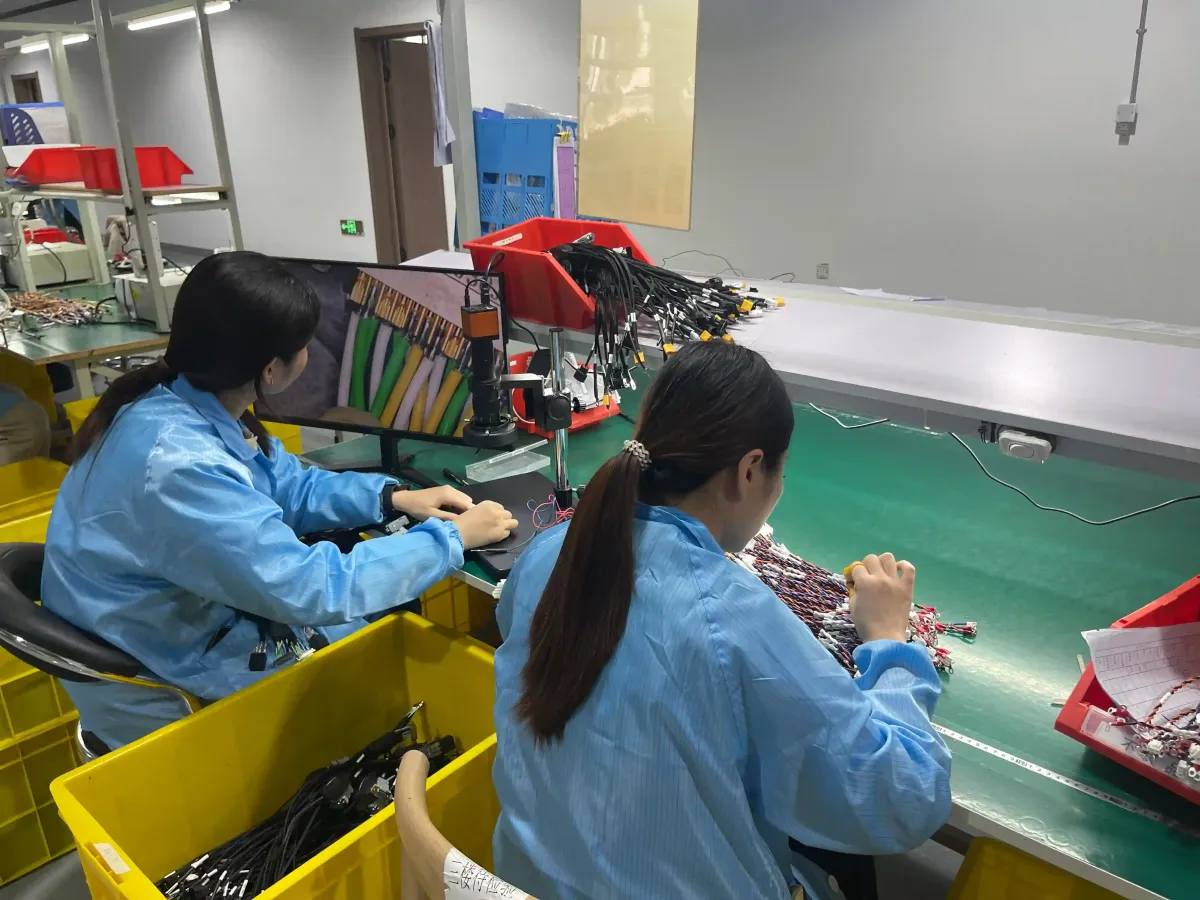
After requirements are released, VeinWire coordinates the control plan and places the order with the manufacturing partner. On the partner's RF coax line, strip dimensions come from the connector manufacturer's drawing, and operators use pneumatic strip stations with mechanical stops. The partner uses Daniels DMC AFM8, M22520/5-01, Pasternack PE5026, or the connector OEM's specified tool and die for hex-crimp builds, then inspects center conductor exposure, dielectric face, braid comb, ferrule position, and jacket support before release. The partner applies IPC/WHMA-A-620 Class 2 or Class 3 workmanship and retains MIL-DTL-17 cable and MIL-PRF-39012 connector documentation where the drawing calls for mil-spec material.
The manufacturing partner matches testing to the failure mode. The partner runs continuity and isolation on CIRRIS 1000H fixtures where the geometry supports it and sweeps RF-sensitive first articles on a Keysight FieldFox N9952A from 100 MHz to the specified upper frequency. Mature production lots can use AQL 1.0 resweep sampling after first-article approval; critical medical imaging, aerospace, or test-fixture builds can require 100% sweep when specified. VeinWire reviews the partner's test evidence against the customer-approved acceptance plan.
Case in production: A test & measurement manufacturer reported a resistance measurement discrepancy on a newly delivered custom coaxial probe cable.
Challenge: The customer's VP of Operations found the measured resistance differed from expectations, which threatened the acceptance of a test batch and the subsequent large-scale production plan.
What we did: Our engineering team collaborated directly with the customer's technical lead to review the test data, identifying that the discrepancy was due to the customer using outdated internal reference data. We jointly confirmed the new, correct resistance requirements for moving forward.
Result: Resolved the technical dispute amicably, secured acceptance of the test batch, and maintained the pipeline for the bulk order.
Concrete numbers: 10km test order, 100km bulk order plan, resistance/impedance precision specs
That case changed the way we write micro-coax acceptance plans. The issue was not that the cable could not carry the signal. The issue was that the specification and test method did not describe the same failure threshold. On any new speed-sensitive coax program, we now ask engineering to freeze the measurement method, fixture, frequency, impedance target, and lot evidence before production starts.
When to contact us
Bring VeinWire into the review when the coax assembly has a 50 ohm or 75 ohm controlled path, a VSWR limit above 1 GHz, a 6 Gbps camera or display signal, a phase-matched pair, an AWG #36 to #44 micro-coax, or a program where a continuity-only release would not satisfy incoming inspection. We are also a fit when industrial automation equipment needs antenna, GNSS, vision, or sensor coax to move from 5-50 pilot pieces into 500-5000 production units without changing the qualified cable family.
Have a drawing or BOM? Submit it at /contact — engineering walks every drawing within 4 business hours.