
A coax jumper can pass continuity and still flatten a receiver at 6 GHz. The drawing says RG-316, 150 mm, SMA both ends, but it omits impedance, VSWR limit, and strip geometry. The lot rings through on a meter, then fails first article because the launch has drifted by 0.4 mm.
That is why coaxial cable ratings have to be specified as a set. A buyer cannot safely quote only cable family and length. For Cable Assembly (hub) work that carries RF, video, antenna, sensor, or timing signals, the rating stack should define the electrical target, the environmental limit, and the production test that proves the assembly still meets both after termination.
Start with impedance before cable family
Coaxial cable is a controlled-impedance transmission line. The two common paths in OEM assemblies are 50 ohm and 75 ohm. Most RF, GNSS, Wi-Fi, cellular, and test-instrument paths use 50 ohm. Broadcast video, SDI-style camera links, and some legacy measurement paths use 75 ohm. The mistake is assuming the connector shell decides the rating. BNC, SMB, and some board connectors exist in both impedance versions, and the center-pin geometry is not interchangeable.
For Coaxial Cable Assemblies, we ask for the impedance target before we quote the cable. RG-316 normally means a 50 ohm PTFE-family coax in many RF drawings, but adjacent coax families and application-specific sleeves can be 75 ohm. A 75 ohm cable crimped into a 50 ohm connector may look correct at inspection, then show a return-loss problem at the receiver. The inverse error is just as expensive: a 50 ohm jumper placed in a 75 ohm video path can pass continuity and still produce reflections the system engineer sees as jitter or frame drop.
The RFQ line should say the impedance in plain text: "50 ohm coax assembly" or "75 ohm coax assembly." If the system has mixed paths, each BOM line needs its own rating. Color coding and connector keying help operators, but they do not replace the impedance callout.
Frequency and VSWR ratings are assembly-level limits
A cable datasheet frequency rating is not the finished assembly rating. The assembly includes the connector launch, ferrule crimp, dielectric trim, braid capture, bend radius, and finished length. One poor termination can turn a cable that is acceptable at 3 GHz into a failed assembly at 6 GHz.
On RF Cable Assemblies, the first electrical question is not "what connector do you want?" It is "what frequency band and acceptance limit do you need?" A practical first-article target for a standard RG-316/SMA build may be VSWR <= 1.25 at 6 GHz and <= 1.5 at 18 GHz when the customer drawing calls for that band. For higher-frequency work, the cable, connector, and fixture have to be selected together; a 26.5 GHz sweep is only meaningful when the connector interface and test setup are rated for it.
Frequency also changes what the inspection team has to measure. At low frequency, continuity, isolation, and visual inspection catch many defects. At RF, dielectric pushback, braid eccentricity, and center-conductor extension become electrical defects. A center conductor that is 0.4 mm long at the connector reference plane can shift the launch enough to move the VSWR trace even though the assembly is not open or shorted.
| Rating line | What it controls | What to put on the drawing |
|---|---|---|
| Impedance | Reflection and signal match | 50 ohm or 75 ohm per BOM line |
| Frequency | Usable bandwidth of cable plus connector | Operating band and first-article sweep range |
| VSWR / return loss | RF launch quality after termination | Acceptance limit at the highest operating frequency |
| Length tolerance | Phase, timing, routing fit | Finished length, such as 500 mm +/-5 mm or 100 mm +/-2 mm |
| Environment | Jacket, dielectric, and connector survival | Temperature, flex, fluid, UV, and service-cycle requirement |
Voltage, power, and jacket ratings are not filler
Coax drawings often treat voltage and jacket temperature as afterthoughts because the signal is small. That is a mistake on pulsed, instrument, and outdoor assemblies. Voltage rating depends on dielectric thickness, dielectric material, connector spacing, and termination geometry. Power handling depends on frequency, conductor size, loss, heat rise, and the enclosure. If either rating matters, the acceptance value should come from the cable and connector OEM datasheets, not from a similar-looking RG family.
Temperature is easier to define but just as easy to under-specify. A cable routed through a warm enclosure may only need a -40 C to +85 C jacket window. A fixture, qualification support assembly, or heat-adjacent sensor lead may need PTFE, FEP, PFA, or a MIL-DTL-17 cable family with matching connector materials. For mil-spec builds, the clean line is MIL-DTL-17 cable on MIL-PRF-39012 connectors with COC retained by lot. Workmanship can then reference IPC/WHMA-A-620, with class language handled separately; our adjacent guide, IPC/WHMA-A-620 Class 2 vs Class 3 explained, covers when that class upgrade is worth specifying.
The practical RFQ rule: if the assembly sees heat, voltage, pulse power, washdown, solvents, flex, or outdoor UV, put the rating on the drawing. "RG-316 SMA cable" is not enough information for a supplier to choose jacket material, crimp die, strain relief, or inspection gates.
Mechanical ratings are where substitutions show up
Most field defects in coax assemblies start as mechanical shortcuts. The wrong cable OD under a ferrule may pass a day-1 tug, then loosen after thermal cycle. A braid that is not evenly combed under the crimp can degrade return loss by 5-8 dB at high frequency. A micro-coax bend tighter than its routing allowance can crack an AWG#40 center conductor after repeated handling.
We treat finished length, length tolerance, minimum bend radius, cable OD, connector ferrule, and packaging as ratings. A 500 mm RG-316 SMA jumper with +/-5 mm length tolerance is not the same production problem as a 100 mm CABLINE-VS 1:1 micro-coax harness with +/-2 mm tolerance. The second assembly needs protected handling, microscope inspection, and an impedance test method that both customer and supplier define the same way.
Tooling matters here. Daniels DMC AFM8, M22520/5-01, Pasternack PE5026, and connector-specific die sets are not interchangeable by operator feel. VeinWire reviews ferrule ID and cable OD at the BOM gate, and the manufacturing partner holds center-conductor extension to the connector application's inspection dimension. On RF builds, a generic crimper is not a cost reduction; it is an uncontrolled process variable.
How VeinWire handles this on customer programs
Our intake gate for coax work starts with six fields: impedance, frequency band, VSWR or insertion-loss limit, cable and connector family, finished length tolerance, and operating environment. If the drawing omits any of those fields, engineering stops the quote and asks before the kit is pulled. That is faster than sorting failed RF traces after a pilot lot is already built.
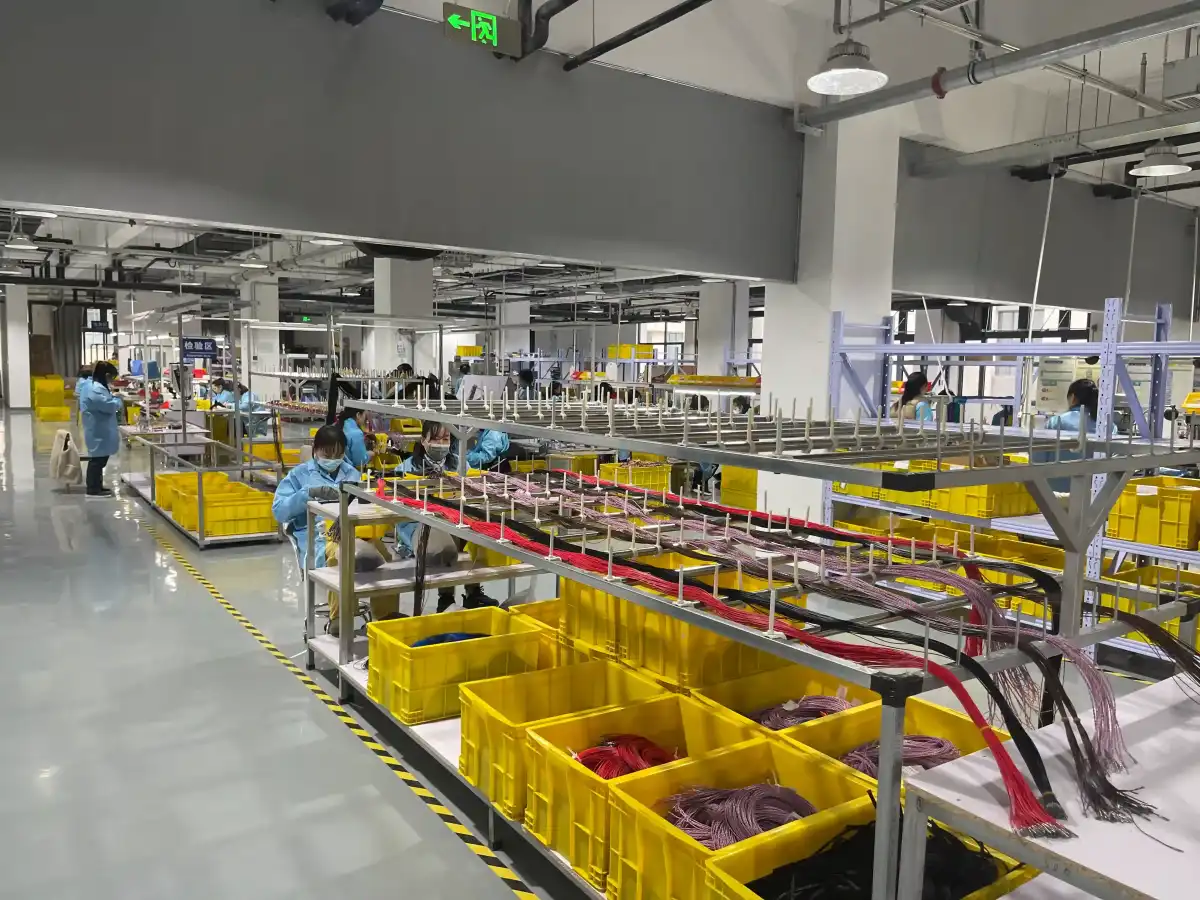
After requirements are released, VeinWire coordinates the control plan and places the order with the manufacturing partner. On the partner's production floor, the operator builds from a strip chart tied to the connector OEM application sheet and checks dielectric face, center-conductor exposure, braid foldback, ferrule position, jacket support, and connector face condition before release. The partner uses Cirris 1000H fixtures for continuity and isolation where the geometry supports it and sweeps RF-sensitive first articles on a Keysight FieldFox N9952A from 100 MHz to the specified upper frequency, attaching the plot to the traveler. Mature production lots can move to AQL 1.0 sample resweep only after the first article and process capability are stable.
VeinWire reviews the quality gate against the failure mode. Continuity catches opens and shorts. Visual inspection catches braid trim, dielectric damage, and connector-face contamination. RF sweep catches the defects that a meter cannot see. No single test should be asked to prove a rating it cannot measure.
Case in production: A high-tech industrial client required a high-temperature probe cable with stricter tolerances than their standard variant.
Challenge: Manufacturing a high volume of spools with tighter tolerances while maintaining a standard production lead time and ensuring consistent quality across the entire batch.
What we did: Aligned the manufacturing partner's production controls with the strict tolerance requirements and coordinated a multi-PO repeat program to support consistent quality and on-time delivery for the high-volume spool order.
Result: Delivered the full volume of spools meeting the tightened tolerance specs within the 4-5 week lead time requirement.
Concrete numbers: 1440 spools, 30 meters per spool, tighter tolerances, 4-5 week lead time
When to contact us
Bring VeinWire in before the coax rating stack is frozen if the assembly has mixed 50 ohm and 75 ohm paths, a customer-defined VSWR limit, micro-coax below AWG#36, MIL-DTL-17 or MIL-PRF-39012 language, or a pilot lot that has to scale from 5-50 samples into 500-5000 production units without changing the cable family.
Have a drawing or BOM? Submit it at /contact — engineering walks every drawing within 4 business hours.