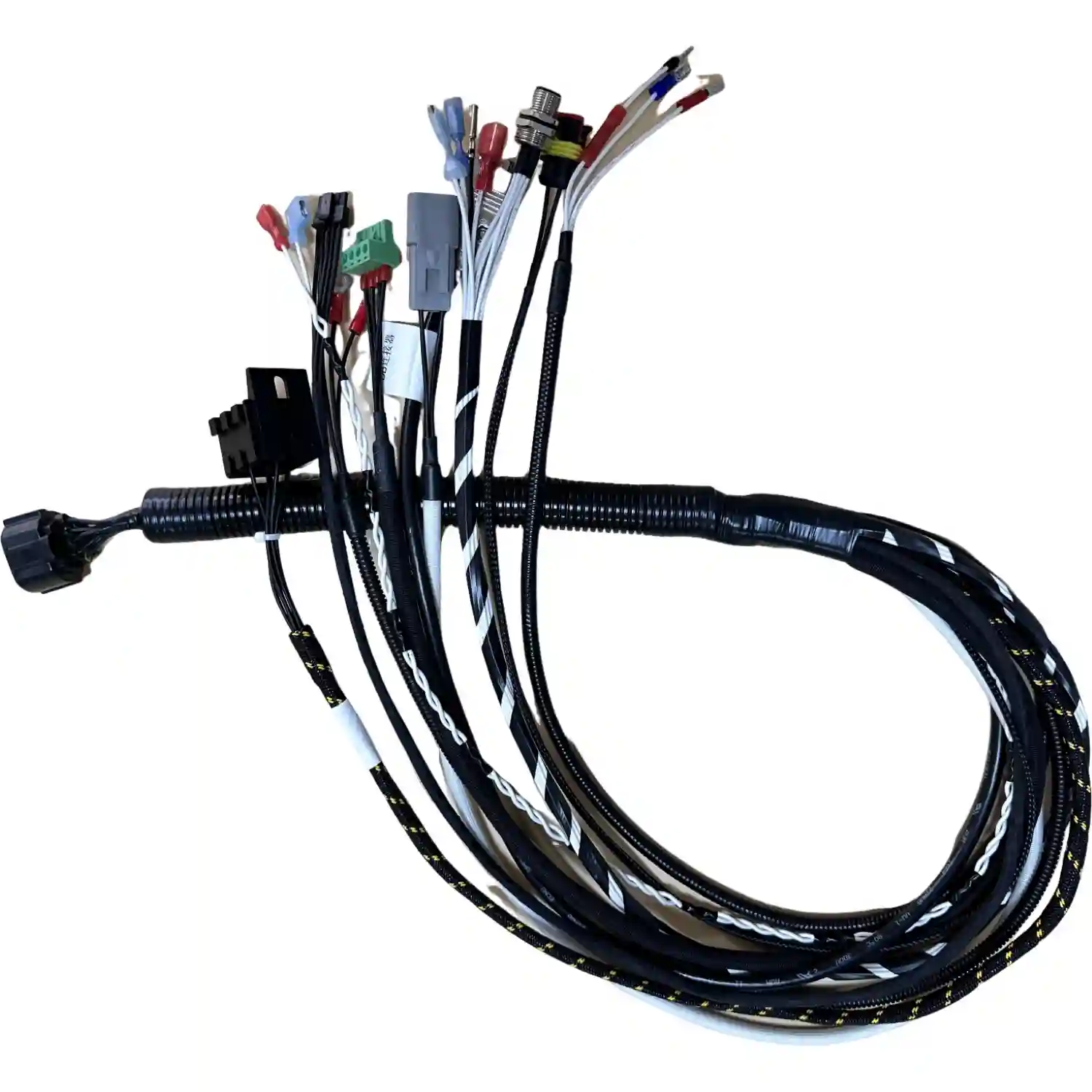

An overmold is the polymer-encapsulated transition between cable and connector. It does three jobs at once: strain relief on the wire bundle, mechanical protection of the connector body, and environmental seal against water, dust, and chemicals. The three jobs pull in different material directions, and the material you pick determines whether your harness lives 18 months in the field or 18 years.
This article walks through the three dominant overmold material families — polyurethane, hot-melt, and silicone — and the mission profiles where each one is the right call. VeinWire sources all three through manufacturing partners for overmolded harness programs. The trade-offs below reflect supplier process data and program experience.
The three families at a glance
| Family | Process | Service temp | UV resistance | Chemical resistance | Relative unit cost |
|---|---|---|---|---|---|
| Polyurethane (TPU) | Injection or low-pressure | -40°C to +85°C (some grades +125°C) | Moderate (UV-stabilized grades good) | Good (oils, fuels); poor (strong solvents) | 1.0× (baseline) |
| Hot-melt (polyamide) | Low-pressure injection | -40°C to +120°C | Moderate | Good | 0.7× (cheapest) |
| Silicone (LSR) | Liquid-injection molding | -60°C to +200°C | Excellent | Good (chemically inert) | 2.5-3.5× (most expensive) |
The unit-cost numbers are first-order approximations across mid-volume runs (1000-10000 units). At very low volume the relative gap closes (tooling dominates); at very high volume polyurethane's cycle time advantage opens it back up.
Polyurethane: the workhorse
Thermoplastic polyurethane (TPU) is the default overmold material for industrial and consumer-adjacent cable assemblies. The combination of flexibility, abrasion resistance, and reasonable cost makes it the right answer 60-70% of the time in programs reviewed by VeinWire.
Typical applications:
- Industrial control cables — flex life is the priority, temperature is moderate.
- Robotics drag-chain cables — TPU survives millions of flex cycles without crack propagation.
- IP67/IP68 sealed connectors on outdoor equipment — UV-stabilized TPU grades like Pellethane or Estane carry warranties for 5-10 year outdoor service.
- Mid-tier medical device patient cables (those not in continuous body-contact applications).
Where polyurethane fails:
- Sustained temperatures above 100°C (most grades soften and lose seal integrity).
- Continuous exposure to aromatic solvents, ketones, or strong acids/bases.
- Steam autoclave sterilization (TPU hydrolyzes at 121°C steam).
For a deeper dive on the chemistry, the thermoplastic polyurethane Wikipedia entry covers the polymer chemistry and the typical grade families.
Hot-melt: the cost-optimized seal
Hot-melt polyamide overmolds (commonly from suppliers like Henkel under the Macromelt brand) are low-pressure injected at 200-230°C and cure in 30-60 seconds. The process pressure is low enough (10-50 bar instead of TPU's 300-1000 bar) that you can overmold directly onto delicate components — small connectors, soldered-pin termini, even encapsulated electronics. The hot-melt adhesive entry on Wikipedia covers the broader chemistry family.
Typical applications:
- Sensor cables where overmolding onto a finished PCB tail is required and high-pressure injection would damage the board.
- Cost-sensitive industrial cables where service temperature is moderate.
- Cable-to-electronics interface seals on consumer-grade equipment.
- Strain relief on JST and Molex connector tails in volume.
Where hot-melt fails:
- Sustained mechanical flex — hot-melts are stiffer than TPU and can crack at the cable interface after 10⁵-10⁶ cycles.
- High-vibration environments — same brittleness story.
- Continuous service above 110°C.
- UV-exposed outdoor surfaces (unless explicitly UV-stabilized grade selected).
Hot-melt is the right answer when cost and damage-free encapsulation matter more than flex life. It is the wrong answer for anything in motion.
Silicone (LSR): the high-end answer
Liquid silicone rubber (LSR) is the premium overmold material. Service temperature from -60°C to +200°C continuous, biocompatible grades for implantable use, excellent UV and ozone resistance, and chemical inertness across most environments. The process is more demanding — two-component injection at 150-180°C cure, longer cycle times, special tooling — and the unit cost lands 2.5-3.5× a comparable TPU part.
Typical applications:
- Medical devices requiring biocompatibility per ISO 10993 — silicone has decades of clinical history.
- Autoclavable patient cables (silicone survives 121°C steam indefinitely).
- Aerospace wire-harness overmolds operating in extreme temperature swings.
- Industrial cables exposed to strong solvents, acids, or sustained outdoor UV.
- Space hardware — silicone outgasses less than TPU in vacuum, lower CVCM/TML per NASA outgassing standards.
Where silicone is the wrong call:
- Cost-sensitive consumer-adjacent industrial cables.
- Applications where abrasion resistance matters — silicone is softer than TPU and tears more easily under sliding friction.
- Programs where the buyer cannot tolerate the 2-3× material premium.
For background on the polymer chemistry, see the silicone rubber Wikipedia entry.
The decision matrix
The 30-second material picker we use during DFM review:
- What is the peak service temperature?
- Below 85°C → polyurethane.
- 85°C to 120°C → upgrade to high-temp polyurethane or hot-melt.
- Above 120°C → silicone.
- Is the cable in continuous mechanical flex?
- Yes → polyurethane (the only material with proven 10⁷+ cycle life).
- No → hot-melt acceptable, silicone acceptable.
- Is the application medical, aerospace, or space?
- Yes → silicone (with biocompatibility or outgassing test data).
- No → continue.
- Is there continuous UV exposure?
- Yes → silicone, or UV-stabilized TPU with documented outdoor warranty.
- No → either material.
- What does the cost budget allow?
- Premium → silicone.
- Mid → polyurethane.
- Tight → hot-melt.
Tooling cost reality
Overmold tooling is a non-trivial NRE for any of the three materials. Steel injection tools for production volumes run USD 8,000-25,000 for a single-cavity tool, more for multi-cavity. Aluminum prototype tools run USD 1,500-5,000 and are good for 500-2,000 shots before degradation. For pilot programs, VeinWire typically recommends aluminum tooling first and coordinates a move to steel with the manufacturing partner only after design freeze. This is the same logic that drives our prototype service pricing model.
Testing your overmold
Whatever material you pick, validate it. A standard qualification plan executed by the manufacturing partner includes:
- IPX water immersion (typically IPX7 — 1m for 30 minutes).
- Pull-force at the cable-overmold interface (per UL 758 specification, 6-30 lbf depending on AWG).
- Thermal cycling per the operating envelope (typically -40°C to +85°C for 100 cycles minimum).
- Mechanical flex life for any cable in motion (per UL or per program-specific spec).
For applications crossing into testing beyond basic continuity, plan for these qualification cycles at the program start, not at first article inspection.
Case in production
An energy management company needed initial physical samples to validate a complex custom overmolded power cable design before committing to production tooling.
Challenge: Standard production molds for overmolded cable assemblies are costly and time-consuming, creating a barrier for early-stage NPI validation requiring only a handful of units.
What we did: Proposed a rapid prototyping approach using silicone molds instead of hard tooling and coordinated the manufacturing partner's allocation of 50 pieces of raw material for an initial batch of 5 sample units.
Result: Delivered functional samples within a 3-4 week turnaround (including 2 weeks for silicone mold creation), enabling the customer to proceed with physical testing and design iteration without upfront hard tooling investment.
Concrete numbers: 5 sample units produced, 50 pieces raw material allocated, 2 weeks silicone mold creation, 3-4 weeks total sample turnaround
Bottom line
Polyurethane is the default. Hot-melt is the cost-optimized option for static cables and low-pressure encapsulation. Silicone is the premium answer for high-temperature, medical, aerospace, and chemically harsh environments. Pick by mission profile, not by what the supplier defaults to — and validate by environmental testing before locking the material into a long-running production program.